Trail technique
How to improve your downhill trail running without getting injured
Learn to descend trails more efficiently with a stable posture, short steps, better vision, and a progression suited to your current level.
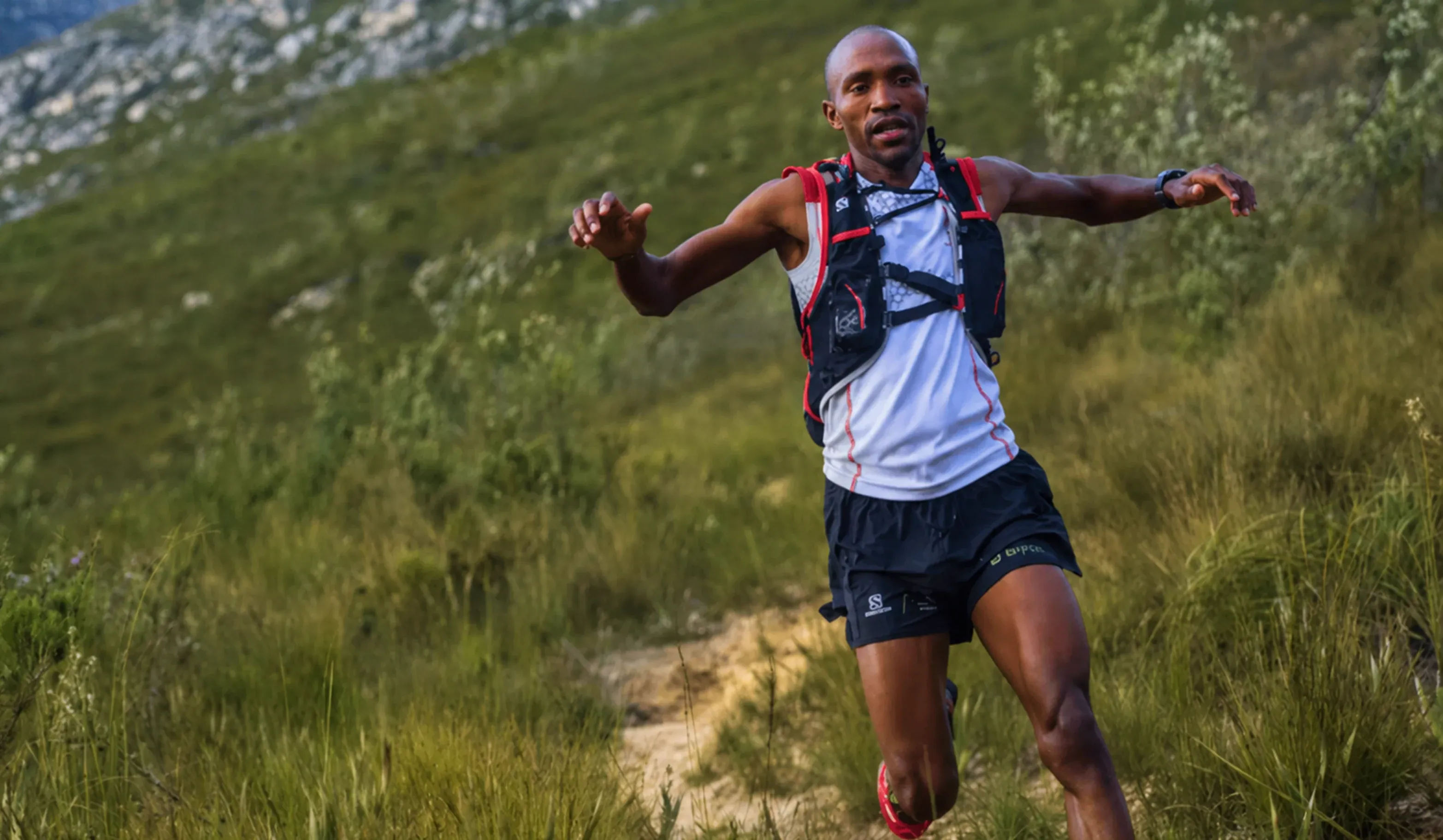
Downhills can save time in a trail race, but they can also cost a lot when fear, burning quads, or inaccurate foot placement take over. Improving does not mean throwing yourself down the slope. It means learning to read the terrain, control speed, and gradually prepare your muscles for repeated braking. No technique can guarantee an injury-free run, but smoother movement and appropriate training load can help you manage the demands more effectively.
Why downhill running is so demanding
On a descent, the quadriceps work heavily through eccentric contractions: they produce force while lengthening to brake the body at each step. This helps explain the heavy legs and soreness that can follow a long downhill, even when breathing still feels easy.
The steeper the slope, the faster the pace, and the longer the descent, the greater the load. Fatigue also reduces foot-placement accuracy. The first way to improve is therefore regular exposure in small doses your body can absorb.
Look where you want to go
Staring at your shoes gives you too little time to react. Look a few metres ahead and alternate between the upcoming line and the area of your next foot placement. Look farther ahead on a fast section and shorten that distance on very technical ground.
Search for a smooth line instead of the perfect rock at every step. Anticipating a root, turn, or gradient change lets you adjust speed before the obstacle and avoids abrupt last-second braking.
Stay mobile and balanced
Keep your torso gently oriented down the slope with relaxed ankles and knees instead of leaning far backward. Sitting back often sends the feet too far ahead and turns every stride into a hard braking action.
Let your arms move slightly wider for balance and keep your shoulders relaxed. Good posture is not a fixed pose: it constantly adapts to turns, drops, and changes in grip.
Shorten your steps before chasing speed
Short, relatively quick steps make line corrections easier and reduce braking at each contact. Try to land with the foot closer to your centre of mass rather than reaching far ahead, without forcing yourself to hit an exact cadence.
Speed should come from fluidity. Start slowly on easy terrain, then increase pace only when your vision, posture, and foot placement remain controlled.
Adapt your technique to the terrain
On a smooth track, you can let the stride open slightly. On rocks, roots, or tight turns, shorten your steps, slow down, and look for stable contact points. On very steep ground, fast hiking may be more efficient and safer than tense running.
Grip changes with mud, rain, and loose dust. Suitable shoes help, but they cannot replace anticipation and control. Always keep enough margin to change your line.
Build downhill training gradually
Start with four to six repetitions of 30 to 60 seconds on a gentle, non-technical slope, walking or jogging easily back up. Focus on one cue at a time: vision, relaxation, or step rhythm. Stop the set when your foot placement becomes less accurate.
Over the following weeks, increase total duration first, then technical difficulty or speed, but not everything at once. Leave recovery between demanding downhill sessions and reduce the load if pain changes your stride. Persistent pain should be assessed by a qualified healthcare professional.
A simple session to improve
- 1 Warm up for 15 minutes and choose a smooth slope you already control.
- 2 Complete 4 to 6 descents of 30 to 60 seconds at a controlled pace.
- 3 Use one cue per repetition: vision, short steps, relaxed arms, or line choice.
- 4 Return uphill easily and recover fully before starting again.
- 5 Increase only one variable from week to week: duration, gradient, terrain, or speed.
Improve on every type of terrain
TrailRun helps you structure your sessions, track progress, and adapt your training to your goal and real-life schedule changes.
Discover TrailRun